

Irish Art Gifts for Christmas: Choosing a Print for the Person You're Buying For
A print given at Christmas gets looked at every day for years, which is a good reason to choose it for one particular person rather than for Ireland in general. The question that helps most is not "what is Irish?" but "who is this for, and what would they stop and look at?"
What follows sorts the catalogue by kind of person — the one who has left Ireland, the one attached to a particular place, the reader, the music lover, and the person who is simply hard to buy for — and then deals with the practical part: size, frame, and how much time to allow for delivery. Every print here is open edition and made to order.
For the person who has left Ireland
Someone living in Boston, Birmingham or Brisbane rarely wants a shamrock. What tends to land is a small, quiet reminder of a particular kind of home — and often a phrase they grew up hearing.
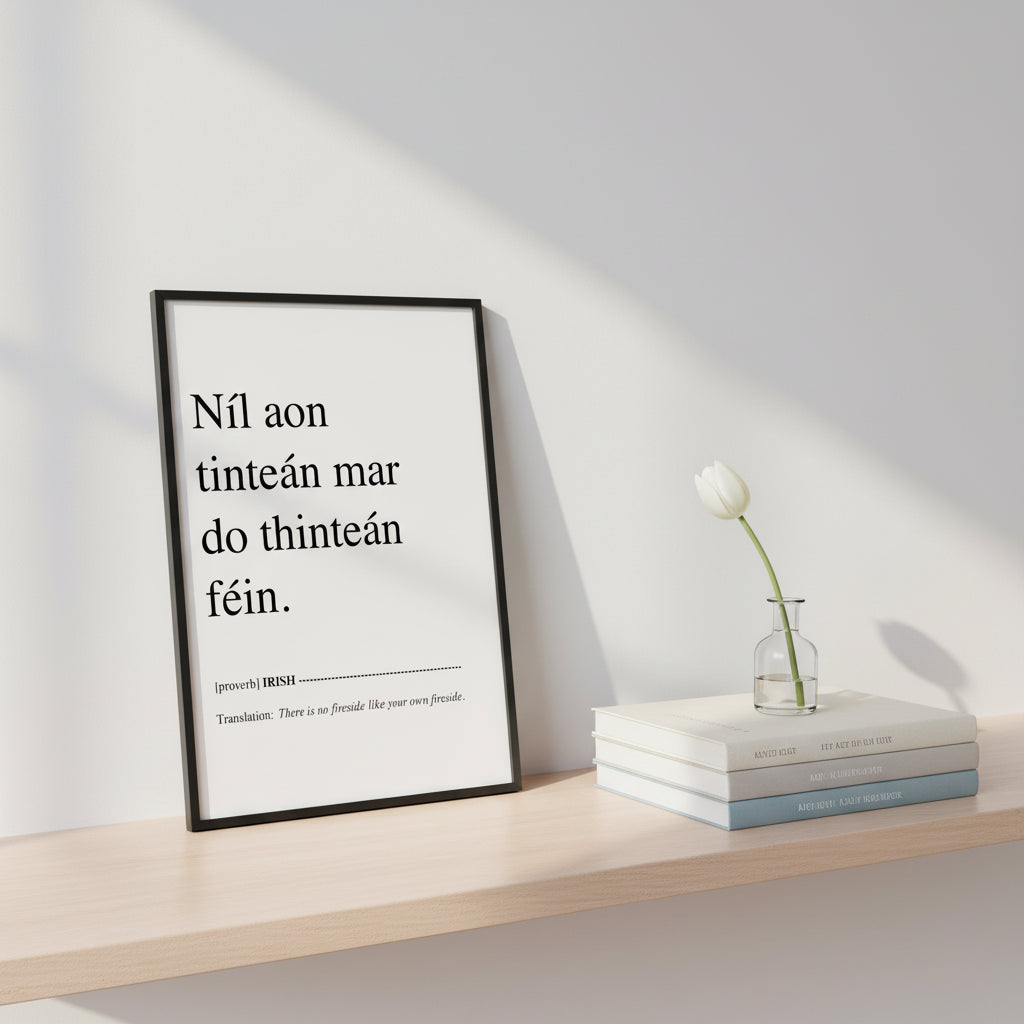
The Irish proverb Níl aon tinteán mar do thinteán féin is a good example. Tinteán means hearth or fireside, and the proverb says there is no hearth like your own — the Irish counterpart of "there's no place like home". Our Níl Aon Tinteán print sets it in type, which makes it a gift that works for a fluent speaker, a learner, and a grandchild who only half remembers the phrase.
If the recipient has no Irish at all, choose a place instead — the next section — and let the picture do the remembering.
For the person who loves a particular place
This is the easiest gift to get right, because the brief writes itself: the county they are from, the coast they holiday on, the bay they swim in. Start with the Irish landscape and seascape prints, where the work runs from Connemara harbours to the Antrim coast to the lakes of Kerry, and look for the picture that matches the light of the place rather than only its name.
For someone who thinks in terms of streets and townlands, a map can be the better gift. Our historic maps of Ireland and Dublin are old cartography, printed for the wall — the sort of picture that gets traced with a finger while the person tells you where they lived. Maps also suit people who would never describe themselves as art lovers.
For the reader
Ireland's writers are unusually well portrayed, and the Irish literature and writers prints gather portraits of the poets, playwrights and novelists a reader already has on the shelf — Yeats, Joyce, Beckett, Heaney among them. The choice within it is mostly a question of temperament: a formal portrait for someone who likes a study or a library wall, something lighter for a kitchen or a hallway.
A useful test is to ask what the person would happily be seen reading in public. Give them that writer.
For the music lover
The Irish music prints run from traditional players and pipers to the singers and songwriters of the last half-century, so it is worth knowing whether your recipient is a session regular or a devoted listener before you choose.
For someone rooted in the tradition, the older end of the story is a good place to look. The portrait of Turlough O'Carolan shows the blind harper-composer of the eighteenth century. According to the Dictionary of Irish Biography he lost his sight to smallpox at eighteen and then travelled Ireland for some forty-five years, writing tunes for the households that hosted him; roughly two hundred and twenty compositions are attributed to him. It is a portrait of a musician whose tunes are still played, for someone who will know exactly which ones.
For the person who is hard to buy for
The person who owns everything is usually easier to please with a picture than with an object, because a picture asks nothing of them. Two directions work reliably.
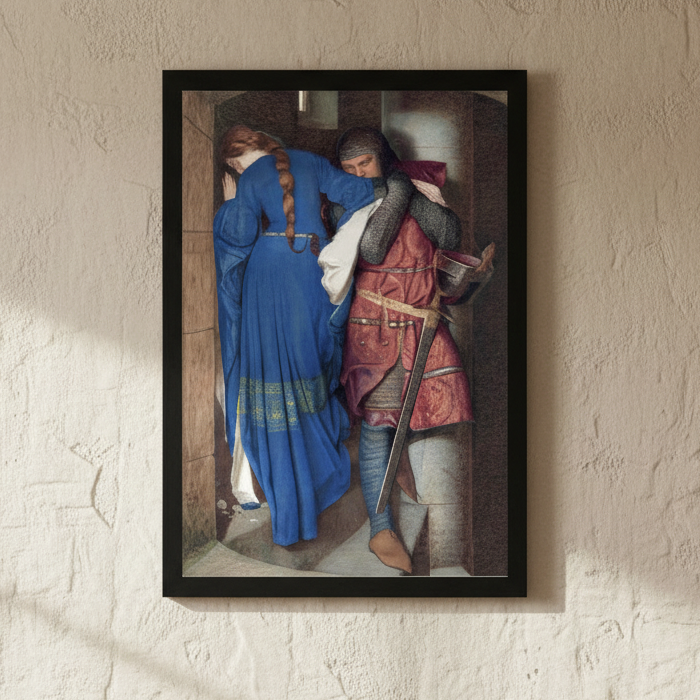
The first is a painting they may already know without having chosen. The Meeting on the Turret Stairs by Frederic William Burton hangs in the National Gallery of Ireland and topped RTÉ's public vote for Ireland's favourite painting, taking 22 per cent. It is a scene of two people parting on a staircase, and it is quiet enough to live with in a bedroom or a hall.
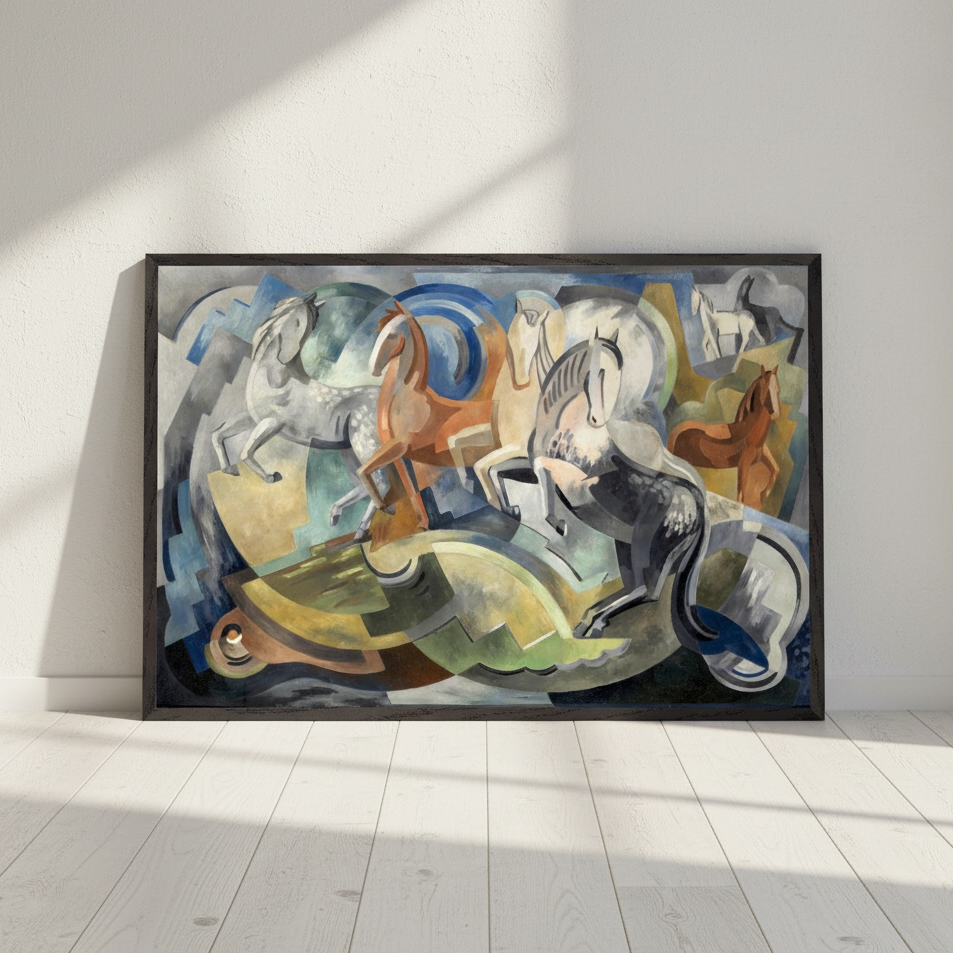
The second is something less expected. Mainie Jellett's Achill Horses, painted in 1941 and part of the National Gallery of Ireland's collection, breaks the animals into geometric shapes in the cubist manner — horses in motion, semi-abstract. It suits someone who would rather hang something modern than a landscape, and it is a good answer to "they have everything and hate clutter".
Choosing a size
Sizes vary from print to print, and each product page lists what is available, so treat the following as a rule of thumb rather than a table.
A small print — around 30 by 40 centimetres — sits on a shelf, a desk or a narrow hallway wall, and is the sensible choice when you do not know the recipient's walls. A medium size, in the region of 45 by 60 centimetres, is the one most people mean when they say "a picture": above a side table, beside a door, at the end of a landing. Larger sizes, 60 by 80 or 60 by 90 centimetres and up, are for a wall that is meant to be looked at — over a sofa or a bed.
If you are unsure, go one size up from where you first landed. A print that is a little large looks deliberate; one that is too small can look lost.
Framed or unframed
The prints above can be ordered framed in black, white or wood, and framed prints arrive ready to hang. That is the simpler gift: nothing further to buy, and no trip to a framer in January.
Unframed suits two kinds of recipient — the person who already has a frame in mind, and the person who lives far away and would rather choose one locally. It is also worth remembering that a frame is a taste decision. If you know the room, choose the frame that matches it; if you do not, black and wood are the least likely to argue with anything.
Allowing time for delivery
Each print is made to order, so delivery is in two parts. According to our shipping policy, a print is dispatched within 2 to 5 business days of the order. After dispatch, delivery takes 3 to 7 business days to Ireland, 4 to 8 to the UK, 5 to 10 to the USA, 6 to 12 to Canada and 7 to 14 to Australia.
Added together, and taking the slowest case at both stages, the arithmetic is as follows. These figures are guidance, not promises.
- Ireland: allow up to 12 business days in all
- United Kingdom: allow up to 13 business days in all
- USA: allow up to 15 business days in all
- Canada: allow up to 17 business days in all
- Australia: allow up to 19 business days in all
Business days exclude weekends and public holidays, so the calendar time is longer than the number suggests, particularly in December. For anywhere not listed, email us at info@buyirishart.com and we will confirm the timing before you order. Tracking details are sent by email when your order is dispatched.
The practical way to use this is to count backwards from the day you would like the gift in hand, using the slower figure for your destination. A note in the card explaining that the gift is on its way costs nothing.
A note on budget
This guide is organised by person. If you would rather begin from a budget, our guide to Irish art gifts by budget takes that route, and the two are meant to be used together: choose the person first, then check the choice against what you want to spend.