The Meeting on the Turret Stairs: the story behind Ireland's favourite painting
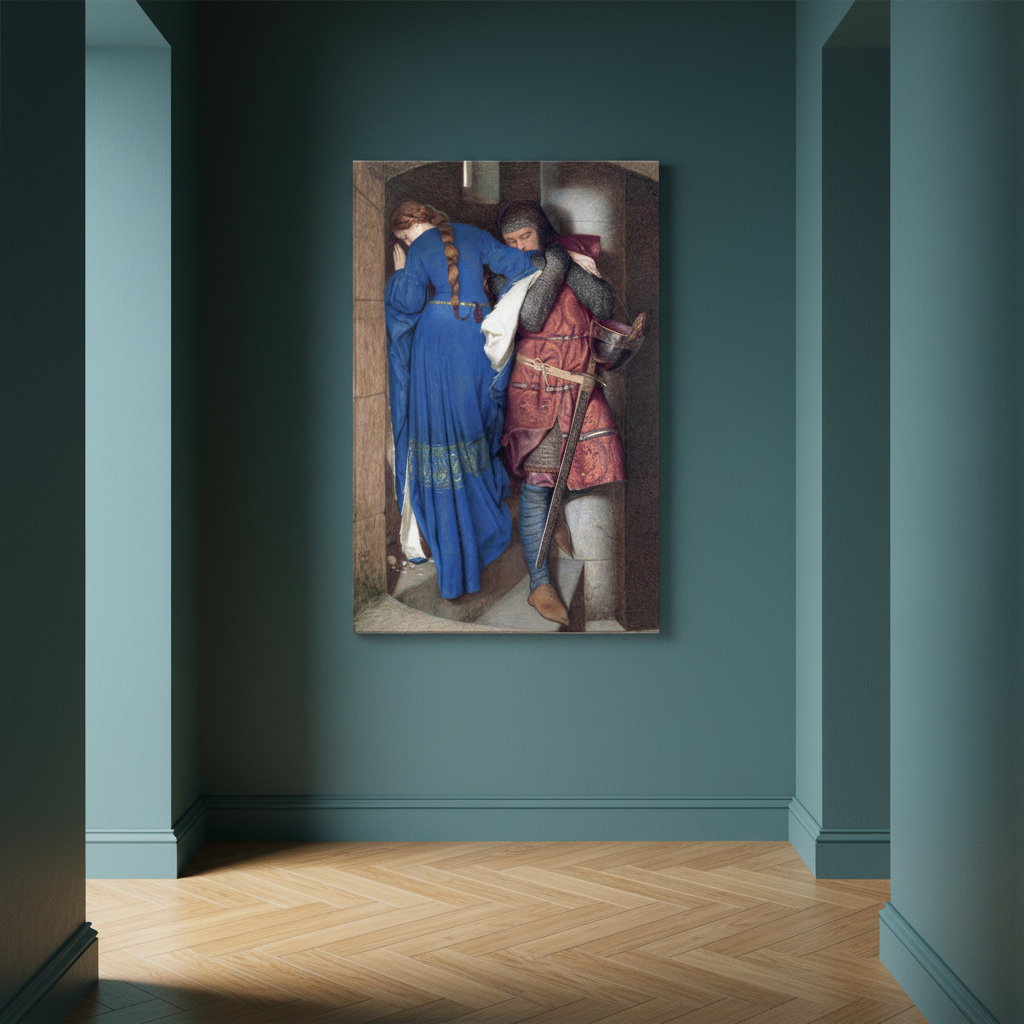
The Meeting on the Turret Stairs is Frederic William Burton's 1864 watercolour of two lovers parting on a spiral stair — a Danish ballad reduced to a single kiss on a sleeve, and the best-known picture in the National Gallery of Ireland. A knight in mail catches a woman's hand as she passes and presses his mouth to her forearm. She does not look at him. Her face is bowed and turned away, her blue sleeve falling across his shoulder, and in a moment she will keep climbing. They will not meet again.
That is the whole painting. Frederic William Burton finished it in 1864, in watercolour, and in 2012 the Irish public voted it the country's favourite painting. It hangs in the National Gallery of Ireland, where you can see it for two hours a week.
The ballad behind it
The story comes from a medieval Danish ballad, which Burton knew through a translation published in 1855 by his friend Whitley Stokes, the Celtic scholar. Hellelil, a king's daughter, falls in love with Hildebrand, Prince of Engelland, who serves as her guard. Her father finds out and sends her seven brothers to kill him.
Hildebrand meets them on the stairs. Before the fight he gives Hellelil one instruction: whatever happens, never speak his name. He kills six brothers. Facing the seventh and youngest, he hears her cry out his name — pleading for the boy's life — and in the second he hesitates, the youngest brother runs him through.
What follows is worse. The brother ties her behind his horse, imprisons her in a tower, and finally sells her for the price of a church bell. She dies telling the story to a Danish queen.
None of that is in the picture.
The moment Burton chose
Out of a ballad full of swords and seven corpses, Burton painted a kiss on a sleeve. The lovers are parting on the turret stair; Hildebrand is on his way down to the fight that will kill him. He catches her hand as she passes and, in the words of a critic reviewing it in The Athenaeum in 1864, "imprints upon her arm a fervid but deferential kiss." Her face is bowed and averted. She receives it and passes upwards.
The restraint is the point. Their faces never meet. Nothing in the picture tells you either of them is about to die, except that Burton has arranged every line of it — the descending stair, the turn of her body, the mail on his back — so that the two of them are already moving in opposite directions.
George Eliot, who saw it, put it exactly: "The subject might have been made the most vulgar thing in the world — the artist has raised it to the highest pitch of refined emotion."
Watercolour that behaves like oil
The painting is watercolour and gouache on paper, 95.5 by 60.8 centimetres. That surprises most people who meet it in a photograph, because the blues have the depth of oil paint and the mail is worked to a point of detail that watercolour is not supposed to reach.
Burton simply could not tolerate the smell of oil paint, and so spent his career on paper. He had trained as a miniaturist, and it shows in the handling: colour built in layer over layer until it holds light the way an oil glaze does. The blue of Hellelil's robe was singled out by reviewers at the time and is still the first thing people describe when they come out of the room.
Why you can almost never see it
Gouache on paper fades. The National Gallery of Ireland keeps the painting in a light-protective cabinet and brings it out for two one-hour sessions a week — Thursday late morning and Sunday afternoon, in Room 20, at lowered light levels. There is a queue.
Since 2026 there has been a second queue, a younger one. The painting found an audience on TikTok, and on a good Sunday the line now runs back from the glass gallery into the courtyard; a gallery guide quoted in The Irish Times in August 2026 put it at a thousand people waiting. The two-hour window did not cause that, but it did not hurt: a picture you can only see on a Thursday morning is a picture worth filming.
This is the strangest fact about the best-known painting in Ireland: almost nobody has stood in front of it. Several generations know it entirely from photographs, book covers and prints, which is a large part of why the picture has the reputation it does. It behaves less like a public monument than like something you have to make an appointment to be told.
The man who painted it
Frederic William Burton was born at Clifden House near Corofin, County Clare, on 8 April 1816, the third son of a landowner who painted as an amateur. An injury in early childhood left his right arm permanently disabled. He trained at the Dublin Society Schools under Henry Brocas and Robert Lucius West, and took lessons in miniature painting from Samuel Lover.
Before the romantic subjects, he was a documentary artist of a kind Ireland badly needed. Between 1838 and 1841 he made repeated journeys to the Aran Islands, frequently in the company of George Petrie, recording a way of life that was already going. He was a founder member of the Irish Archaeological Society in 1840. The paintings from those years — The Blind Girl at the Holy Well, The Aran Fisherman's Drowned Child — are the work of someone who went and looked.
In 1874 he was appointed Director of the National Gallery in London, and he stopped painting. Not gradually: entirely. For the last twenty-six years of his life he bought pictures for other people to look at instead of making his own. He was knighted in 1884, retired in 1894, and died in Kensington in March 1900.
The painting came to the National Gallery of Ireland in the year Burton died, bequeathed by Margaret McNair Stokes — antiquarian, illustrator, historian of early Christian Irish art, and sister of the man whose translation had given Burton the story in the first place. She died in September 1900, six months after him. The ballad, the picture and the bequest all came out of the same circle of friends, and then it went to the nation.

Ireland's favourite painting
In 2012, RTÉ and An Post ran a public vote to find Ireland's favourite painting. A long list of one hundred works was nominated by the public and by the curators and directors of public collections around the country, then cut to a shortlist of ten. President Michael D. Higgins announced the result on a special edition of The Works on 24 May 2012.
It won with 22% of the vote, putting Caravaggio's The Taking of Christ second. A watercolour, made from a Danish ballad, by a Clare-born miniaturist who gave up painting at fifty-eight — beating the field in a country not short of paintings.
Part of the reason is that it does not require you to know any of the above. You can walk up to it knowing nothing about Hellelil or Hildebrand or Whitley Stokes and still read the whole thing off the picture: that this is the last time, that he knows it and she does not, or that she knows and cannot say. The ballad only confirms what the sleeve already told you.
Living with it
Because the original can only be shown a few hours a week, most people who love this painting live with it in another form. We print it on archival matte paper, framed or unframed, made to order and shipped worldwide.
See The Meeting on the Turret Stairs as an art print, or on stretched canvas, ready to hang. More of Burton's work is in our Frederic William Burton collection.
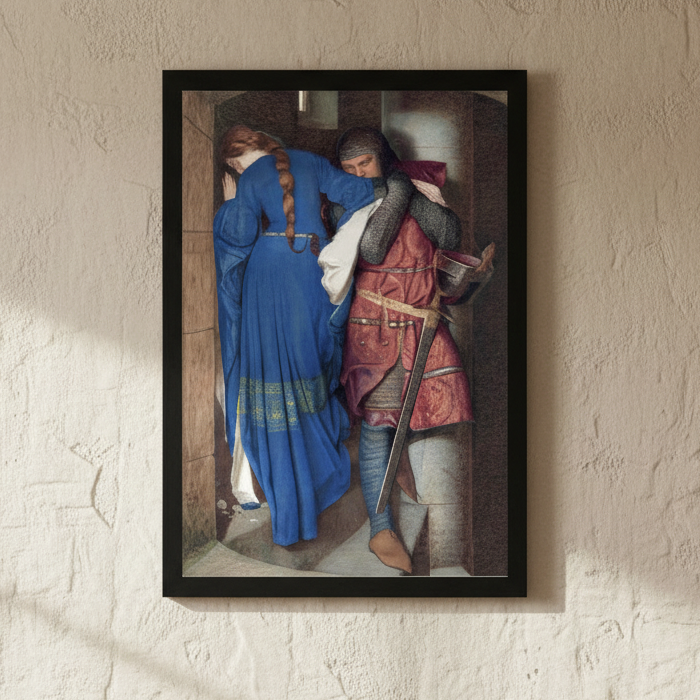
The painting: Frederic William Burton (1816–1900), Hellelil and Hildebrand, the Meeting on the Turret Stairs, 1864. Watercolour and gouache on paper, 95.5 × 60.8 cm. National Gallery of Ireland, NGI.2358. Bequeathed by Miss Margaret Stokes, 1900.