

Irish Impressionism: The Painters Who Took Ireland Outdoors
There was never an Irish Impressionist movement in the way there was a French one: no group exhibition, no manifesto, no café where everyone argued. What there was, between roughly 1850 and the First World War, was a generation of Irish painters who left home to train in Belgium and France, learned to work outdoors in changing light, and carried that habit back with them. In 1984 the art historian Julian Campbell gathered them into an exhibition at the National Gallery of Ireland, The Irish Impressionists: Irish Artists in France and Belgium, 1850–1914, and the name has stuck.
This is a short guide to who they were, what they were after, and how to start looking at their work.
Why they left
Dublin in the second half of the nineteenth century had an academy and a school of art, but the ideas reshaping painting were being worked out on the Continent. Ambitious students went to the Antwerp academy, to the open studios of Paris such as the Académie Julian, and then, in the summers, to the artists' colonies that had grown up in the French countryside: Barbizon and Grez-sur-Loing near the forest of Fontainebleau, and Pont-Aven and Concarneau in Brittany.
Those colonies mattered as much as the schools. They were cheap, full of other young painters, and organised around one idea: that you should paint the motif in front of you, outside, at the hour you saw it. In English that became "plein-air" painting, and it is the thread that ties the Irish group together more than any shared style.
Nathaniel Hone the Younger: the first to go
Nathaniel Hone the Younger (1831–1917) went earliest and stayed longest. Trained first as an engineer, he moved to France in the 1850s, fell in with followers of Corot at Barbizon, and spent some seventeen years there learning to handle colour, texture and tone in landscape. When he came home he settled at Malahide, north of Dublin, and painted its fields, cattle and the sea with a broad, confident touch. His The Wave shows how far he had moved from the polished studio landscape.
Walter Osborne: Antwerp, Brittany, Dublin
Walter Osborne (1859–1903) entered the Antwerp academy in 1881 and studied under Charles Verlat, absorbing the realist tradition of French and Flemish painting. He then spent a year in Brittany, working at Dinan, Pont-Aven and Quimperlé, where he fell under the influence of the French naturalist Jules Bastien-Lepage.
Back in Dublin he turned that training on his own city: markets, quays, parks, and the ordinary people in them. In a Dublin Park, Light and Shade is the picture to start with, all dappled light and loosened brushwork. He died of pneumonia in 1903, aged forty-three. There is more on his life on our Walter Osborne artist page.
John Lavery: Grez and the open air
John Lavery (1856–1941), born in Belfast and trained in Glasgow, went to Paris in the early 1880s and spent the summers of 1883 and 1884 at Grez-sur-Loing. It was there that he developed his plein-air manner, painting directly from nature on the river bank. A Grey Summer's Day, Grez dates from that first summer. Lavery went on to become one of the most successful portraitists of his age, but the light he found at Grez never quite left his work. See our John Lavery page for the rest of the story.
Roderic O'Conor: past Impressionism
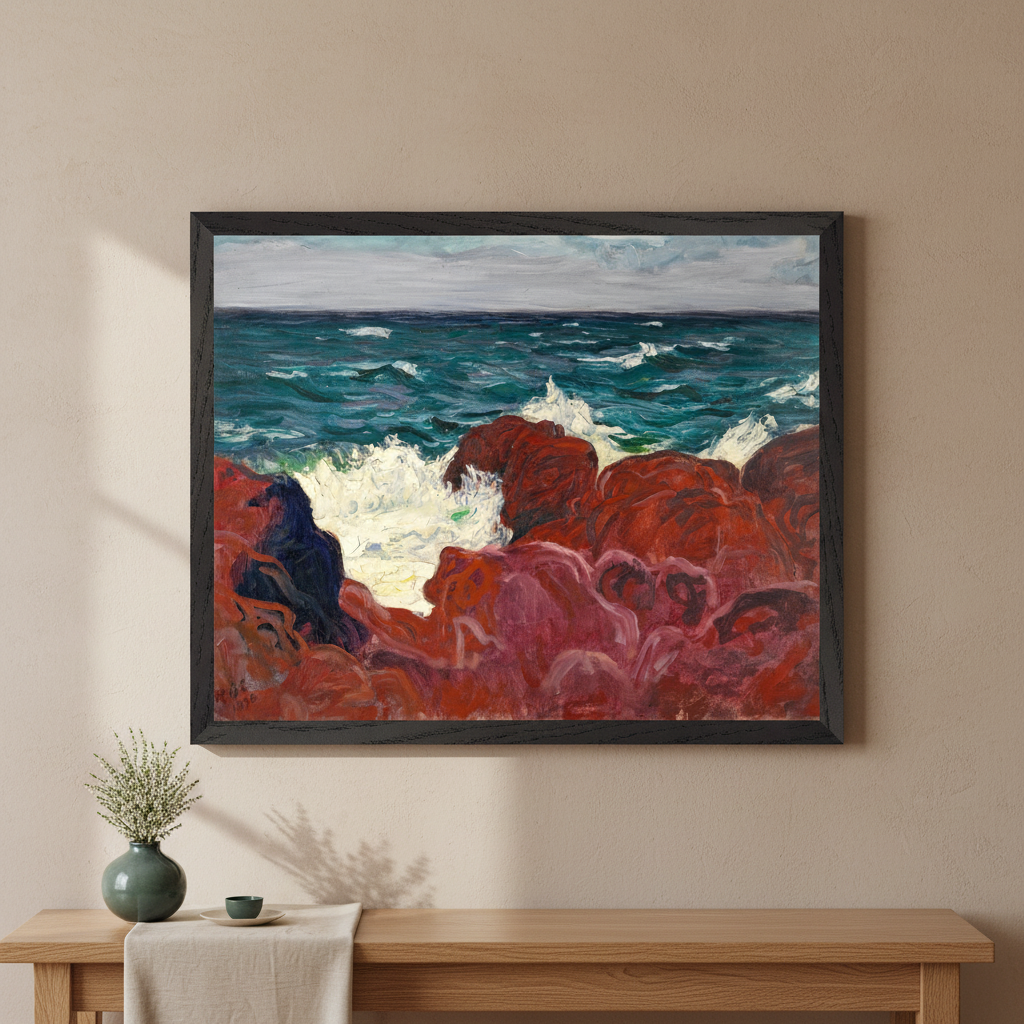
Roderic O'Conor (1860–1940) followed the same route to Antwerp and Paris but went further than the others, both in distance and in style. He settled in Brittany, painted alongside Gauguin at Pont-Aven, and developed a way of building pictures out of thick, parallel stripes of strong colour. Strictly he belongs with the Post-Impressionists, but he is impossible to leave out of the Irish story. Red Rocks and Sea shows what happened when he turned that method on the Breton coast. Our Roderic O'Conor page has more.
Sarah Purser and the women who went
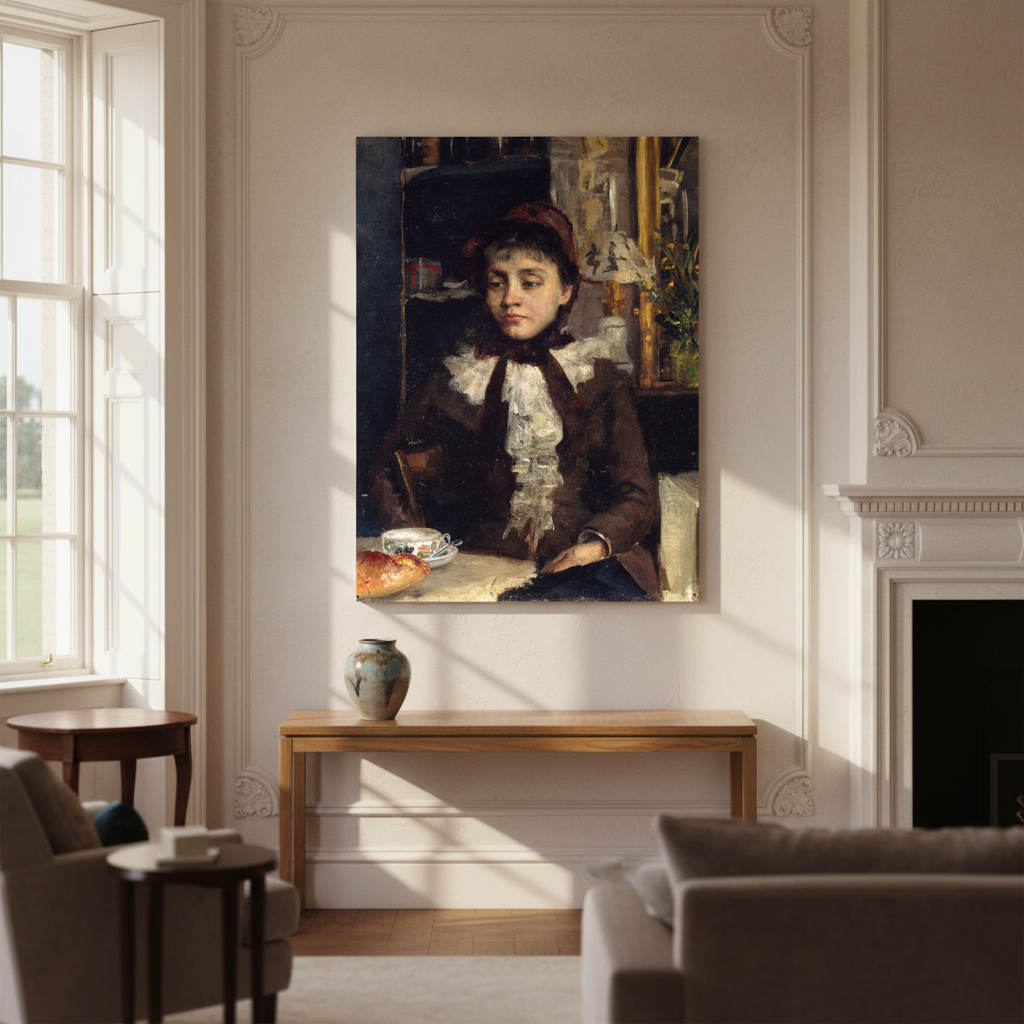
The route was open to women too, if less easily. Sarah Purser (1848–1943) studied at the Académie Julian in Paris at the end of the 1870s, and Le Petit Déjeuner (1881) carries that Parisian looseness of handling into an intimate interior. She went on to become one of the great organisers of Irish art. Mildred Anne Butler, painting the gardens and animals of her family home at Kilmurry in Co. Kilkenny, brought a comparable lightness to watercolour.
How to look at it
If French Impressionism is about light dissolving form, the Irish version tends to keep a firmer hold on the subject. Most of these painters trained in academic drawing first and never quite let it go. What changed was where and when they painted: outdoors, quickly, with an eye on weather and time of day. Look for shadows that carry colour rather than plain grey, edges that soften where the light falls, and figures caught in the middle of something rather than posed for it.

That is also why the work suits a home so well. These are mostly modest, lived-in pictures of parks, rivers, harbours and fields, and they bring daylight into a room.
Where to start
The Impressionist collection gathers the Irish Impressionist and Post-Impressionist work we print in one place, from Osborne's Dublin to O'Conor's Brittany. For the wider landscape tradition the movement grew out of, browse Irish Landscape & Seascape Art Prints, or go to the full range of Irish art prints.
Every print is made from a public-domain image of the original painting, on archival matte paper, framed or unframed, and made to order.